Invoicing & Payments
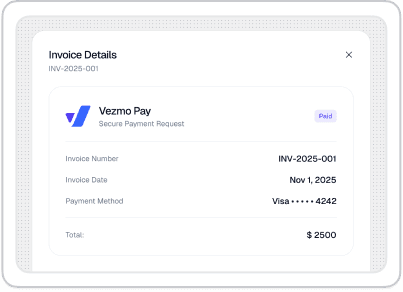
Send polished invoices, automate reminders, and get paid faster with multiple payment options.

Reach out now and get expert guidance tailored to your project needs.
Copyright © 2025 Vezmo Technology , Inc. All rights reserved
Vezmo is the registered trademarks of Vezmo Technology, Inc.
Blog›Get paid faster: 7 invoice ...
If you want to get paid faster on invoices, you don’t need a tougher personality or more “follow-ups.” You need an invoice and process that removes friction and makes the next step obvious. The goal isn’t to pressure good clients—it’s to make paying you the easiest thing they do all week.
This playbook focuses on seven changes you can implement without re-platforming your finance stack. Each one is small on its own, but together they can materially improve accounts receivable and drive real DSO reduction—often without a single awkward email.
Most invoices bury the due date in a corner and label it with something vague like “Net 30.” The client sees it, but they don’t feel it. Your first job is to make the due date clear, specific, and framed as an action.
Why this works: “Net 30” forces the customer to do date math. A calendar date is instant comprehension. “Schedule payment” also matches how many finance teams actually work—they batch and schedule, not “pay someday.”
A lot of businesses copy default invoice payment terms that don’t match the actual delivery and approval cycle. You can’t collect faster than the client can approve. But you also shouldn’t finance your customer’s operations by accident.
Set terms so the client has a fair window after they receive the invoice, not after you complete the work.
Even a modest change—moving from “invoice on the last day of the month” to “invoice every Monday”—can pull cash forward by 7–15 days for no extra work.
Early-pay discounts can be powerful, but only if the numbers make sense. A common mistake is giving away margin for a discount that doesn’t reliably change behavior.
Say your invoice is $10,000 and the client usually pays in 40 days. You consider “2% off if paid within 10 days.” That’s a $200 discount to get paid 30 days earlier.
Annualized, that’s roughly:
Implied cost $90 $10? Actually compute the effective rate:
If your alternative is borrowing at 10–14% or running tight payroll weeks, a 1–2% early-pay incentive can be a smart trade. If your margins are thin and your cash is stable, it may be too expensive.
Practical guidance: start with 1% for 10 days on clients who are consistently late, then keep it only if it moves payment behavior.
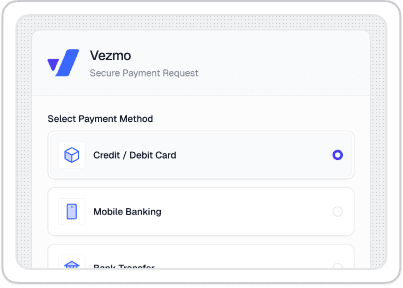
Clients often pay the way you nudge them to pay. If the first option is a bank transfer button, many will take it. If the first option is “mail a check,” you’ve just added a week.
In VezmoBooks and VezmoPay, the practical win is less back-and-forth: the invoice includes a clear pay path, and your team isn’t manually sending separate payment instructions.
If your invoices are large enough that they trigger extra approvals, asking for 100% at the end is often the slowest path. You can improve cash flow and reduce disputes by splitting the invoice into a deposit and clear milestones.
This does two things: it reduces your risk (you’re not floating the full project), and it makes each payment “smaller” in the client’s internal process—often lowering the threshold for quick approval.
For ongoing services, the fastest invoice is the one that doesn’t need an approval cycle each month. If you do retainers, maintenance plans, or repeat monthly work, consider moving to a card-on-file authorization with a clear consent clause.
This is also a relationship play: clients who trust you enough for card-on-file usually churn less and complain less. You’re removing admin hassle for them too.
Many customers don’t forget to pay—you fall off their radar. A monthly statement arrives too late to change the week-to-week priority order inside their payables queue.
Keep it short. The goal is to help their finance team do their job, not to lecture them.
Track two numbers for 30–60 days: average days to first response after invoice send, and average days to payment. If those move, your process is working—even before your average DSO fully resets.
When you design for clarity—clear due dates, sane terms, easy payment methods, and predictable reminders—you reduce the “human friction” that slows payments down. If you want a lightweight way to run this end-to-end, VezmoBooks paired with VezmoPay can help you send cleaner invoices, collect faster, and keep your accounts receivable organized without adding admin work.
If you pick just one change this week, start with the due date wording and the payment path placement. It’s the smallest tweak that often produces the quickest cash impact.