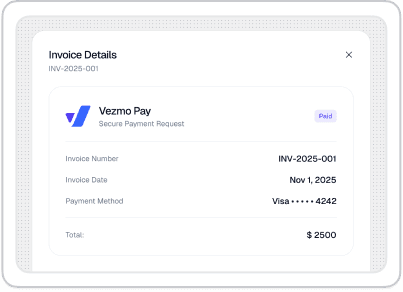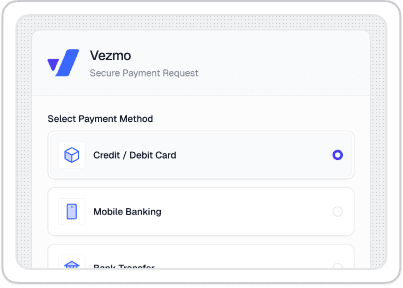
Invoicing & Payments
Send polished invoices, automate reminders, and get paid faster with multiple payment options.

Reach out now and get expert guidance tailored to your project needs.
Copyright © 2025 Vezmo Technology , Inc. All rights reserved
Vezmo is the registered trademarks of Vezmo Technology, Inc.
Blog›Service business margins: w...
Most service businesses don’t go bankrupt because they can’t sell. They quietly bleed margin in five or six small places until “busy” stops meaning “profitable.” The painful part is that the owner often can’t point to a single bad decision—just a lot of normal ones that add up.
This post breaks down service business profit margin benchmarks (and what the median really looks like), then shows the specific cost lines that erode margin invisibly—card fees, scope creep, tool sprawl, and the rebilling gaps that turn great projects into mediocre ones.
If you’re running an agency, consulting shop, or a productized service, you’ll hear a lot of confident numbers. The reality is more boring: the typical firm lands in a narrow band, and tiny operating mistakes push you below it.
Across many consulting margins and agency P&Ls, a useful mental model is:
That’s why you’ll see agency margin benchmarks talked about as “11–15% net” for a median-ish business: not a dream outcome, just the center of gravity once overhead and slippage show up. If you’re at 3–7% net, it doesn’t mean you’re bad at delivery; it usually means you’re letting small leaks compound.
Payment costs rarely feel like a “problem” because they’re small per invoice—until you do the math against net profit.
Example: say you do AED 150,000/month in revenue. You run at a 12% net margin (AED 18,000/month net profit). If 60% of clients pay by card and the blended fee is 2.9%, then your monthly card fees are:
That AED 2,610 is not “2.9% of revenue” in the way it feels. It’s 14.5% of your net profit (AED 2,610 ÷ AED 18,000). That’s why founders experience card fees as a margin tax.
Two practical moves:
Tools like VezmoPay matter here because the payment experience changes behavior: when invoices are clear, reminders are automatic, and options are visible, you get fewer “we missed it” delays and a cleaner mix of payment methods.
Subscription tools kill service business profitability in a very specific way: each one is “only” AED 80–300/month, and every team member has a different stack. Six months later you’re paying for overlapping features and nobody remembers why.
Do a quick audit using three columns:
Then apply a simple rule: if a tool doesn’t either (1) increase billable utilization, (2) reduce delivery time, or (3) improve cash collection, it must be justified like a luxury.
Worked math: cutting AED 3,500/month of unused subscriptions improves a business at AED 150,000/month revenue by 2.3 percentage points of net margin (AED 3,500 ÷ AED 150,000). That’s the difference between “we’re fine” and “we can hire.”
Scope creep shows up as kindness: an extra revision, a “quick call,” a small add-on “to keep things moving.” You only notice it when your team is overloaded and projects that should be profitable feel heavy.
Fixing it is less about saying no and more about making boundaries legible:
Here’s the simple math most owners underestimate: if a project is priced at AED 40,000 for 200 hours (AED 200/hour effective rate), and you “donate” 30 hours across extra rounds and calls, your effective rate drops to AED 174/hour. That’s a 13% price cut you never approved.
Rebill mismatch is the least dramatic leak and one of the most common. It happens when you incur pass-through costs (contractors, ad spend management time, travel, special software, rush fees), and your contract says you can rebill them, but your process doesn’t make it easy.
Common causes:
A practical fix is operational, not philosophical: set a weekly “rebill close” where someone (often ops) checks every project for new pass-through costs and adds them to the next invoice with a plain-English label.
If you miss just AED 2,000/week in rebillable costs, that’s AED 8,000/month. On a business doing AED 150,000/month, that alone is 5.3 margin points. Most owners will fight hard for 5 points in pricing—and then give it away in rebilling.
If you want a fast diagnosis, run this one-hour review:
If you’re running VezmoBooks and VezmoCashflow, this kind of review is much easier because your invoicing, expenses, and collections live in one system—so you can spot the “invisible” leaks before they become a quarterly surprise.
The good news: most service businesses don’t need a new strategy to improve margins. They need fewer leaks. Tighten payment economics, reduce tool sprawl, package scope clearly, and close rebills weekly—and you’ll often move from the median to the top quartile without changing what you sell.
If you want, start by fixing just one leak this week and track the impact for 30 days. Margin improvements compound faster than new sales.