Invoicing & Payments
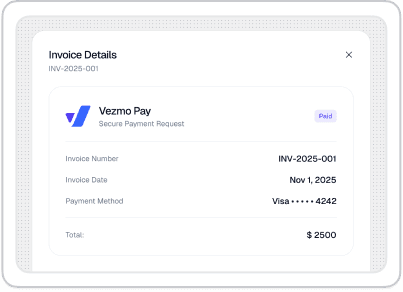
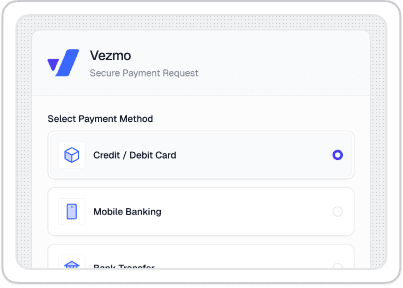
Send polished invoices, automate reminders, and get paid faster with multiple payment options.

Reach out now and get expert guidance tailored to your project needs.
Copyright © 2025 Vezmo Technology , Inc. All rights reserved
Vezmo is the registered trademarks of Vezmo Technology, Inc.
Blog›Split invoicing: a 50/50 de...
Theres a moment every service business owner knows: the work is done, the client is happy, you send the invoiceand then you wait. A single final invoice sounds clean, but it quietly turns your cash flow into a guessing game.
A simple fix is split invoicing: collect a deposit up front and the remainder at delivery. In this post, well break down why a 50/50 deposit and final invoice often beats a single end-of-project bill, how it changes client behavior, and how to set it up without creating friction.
Most late payments arent caused by bad clients. Theyre caused by the invoice landing at the wrong time: your email hits an overloaded inbox, the approver is traveling, or the client suddenly has three other priorities.
Two invoices reduce that risk for a simple reason: they create two chances to get paid, and each one feels more reasonable.
Lets put numbers on it. Assume a 20,000 project, 30-day payment terms, and a 30-day delivery timeline.
In practice, thats ~60 days of you funding the work.
Even if the final invoice takes just as long, youve pulled 10,000 forward by roughly 5060 days. That shift does three things:
Could you ask for 70/30 or 100% up front? Sometimes. But 50/50 is a strong default because it feels fair while still giving you meaningful protection.
Scope creep usually shows up between the deposit is paid and the project is almost done. When you bill only at the end, youre negotiating changes from a weak positionyouve already invested the time.
With a split structure, you can tie the second invoice to a concrete deliverable or milestone:
If the work expands, you have a clean moment to adjust: We can add thatheres the change order and the updated milestone payment. That is much easier than arguing after everything is delivered.
Not every project fits a perfect 50/50 split. For longer engagements, milestone payments (a form of progress billing) can be even better. The rule is simple: bill at moments the client already agrees are meaningful.
Three practical patterns:
Whatever you pick, keep the invoice language plain:
Clients dont want billing complexity; they want predictability. Your job is to make the schedule obvious and the amounts consistent with how the project is delivered.
Split invoicing fails when its presented as a surprise or enforced inconsistently. A few operator-level fixes:
One more important detail: if you accept card payments, remember that card processors charge fees on each transaction. Two invoices can mean two processing events. For many teams, the cash flow stability is still worth it, but its good to price with that reality in mind.
The goal isnt just getting paid twice. Its building a billing system that clients understand and your team can repeat. With Vezmo, you can set up a split invoice schedule, track whats been paid, and keep the remaining balance obvious so theres no awkward back-and-forth.
If youre already using VezmoPay for collections and VezmoBooks for your bookkeeping workflow, split invoicing becomes a habit: deposit at kickoff, final invoice at delivery, and a clearer picture of your short-term cash position inside VezmoCashflow.
Start with a 50/50 deposit and final invoice on your next project. After two or three cycles, youll usually find the same work feels calmerbecause your cash flow stops hinging on a single email at the end.