Invoicing & Payments
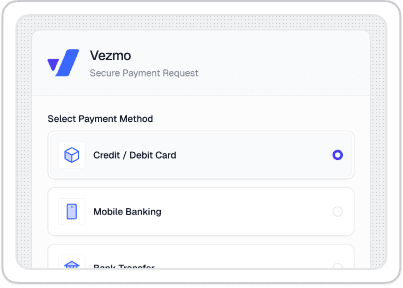
Send polished invoices, automate reminders, and get paid faster with multiple payment options.

Blog›The quiet case for ACH: why...
Why a growing number of service businesses are quietly moving away from card rails — and what changes when you do.
Most owners I talk to start with the same instinct: cards are easy, customers are used to them, and the fees feel like a cost of doing business. That instinct made sense for a decade. It is starting to make less sense every quarter.
Card rails were built for a different kind of commerce — coffee shops, retail counters, $40 transactions where speed at the till matters more than basis points. Service businesses look nothing like that. A typical Vezmo customer sends invoices that average $1,800, gets paid 4 to 12 times a month, and runs on margins that flinch at every percent. That is the world where ACH stops being a back-office curiosity and starts being a real lever.
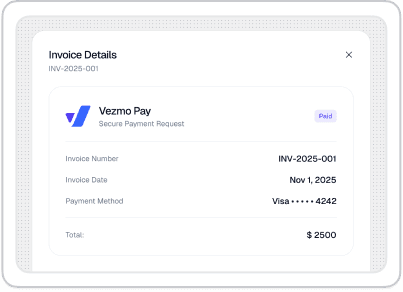
Here is the spread that surprises people. On a $2,500 invoice, a typical card processor takes about $73. That same payment over ACH on VezmoPay costs less than $1. Multiply that by the 60–80 invoices a small agency or contractor sends in a year and you are looking at four figures of pure margin sitting on the table.
It gets larger as you grow. We ran the numbers on a Vezmo customer with $480k in annual collections last year:
That is a $13,608 swing. For a 4-person service team that is a real new hire, a real ad budget, a real bonus pool. It does not feel exciting at sign-up because each invoice only saves $70. It compounds quietly until you look at year-end.
I hear this constantly. It usually is not true any more. Three things changed in the last few years:
The friction left in ACH is mostly UX friction, not rail friction. Build the checkout right and clients pay it the same way they pay a card.
I want to be honest about the trade-offs, because it is not a free lunch.
You give up some speed. Card auth happens in milliseconds. ACH takes 1–2 business days for most flows, same-day if you push it. If you are running a flash sale or a digital download where the customer expects instant fulfillment, keep cards as an option.
You give up some chargeback shielding. Card networks reverse disputes aggressively. ACH disputes exist but the time windows are tighter and the burden of proof sits more squarely on the customer. For service work with signed contracts, this is usually a feature, not a bug.
You gain margin, predictability, and reconciliation. ACH posts as a single line item with a clear sender. Card payments arrive as net deposits two days later, after fees, in batches that take time to match. Bookkeeping gets quieter the moment you switch.
The mistake I see most often is "I am turning off cards next Monday." Do not do that. The pattern that works:
Inside Vezmo this is one toggle on the invoice template. It is the kind of change that takes 90 seconds to ship and shows up in your P&L six months later.
I will not pretend it is the right answer for everyone. ACH is a worse fit when:
For everyone else — agencies, contractors, consultants, B2B service businesses, recurring retainers — the math leans toward ACH harder than people realize.
If you walked through 50 of our top-billing accounts a year ago, around 22% of their volume came in over ACH. Today it is closer to 41%, and the curve still bends up. The owners did not announce it. They quietly toggled it on, watched the savings post for two months, and never went back.
Cards are not going anywhere — they remain the right tool for a long list of jobs. But for the kind of work most Vezmo customers do, a default of "ACH first, card as a backup" is the trade most people regret not making sooner.
If you are running invoices through Vezmo today and have not flipped that default, it is worth ten minutes of your week. Worst case, you turn it off again. Best case, you find a few thousand dollars a year that was always yours.
Reach out now and get expert guidance tailored to your project needs.
Copyright © 2025 Vezmo Technology , Inc. All rights reserved
Vezmo is the registered trademarks of Vezmo Technology, Inc.